

CMAT 2026 preparation tips for Language Comprehension mentioned here aim to guide CMAT aspirants on how to prepare for this section in a manner that helps them achieve the highest score possible.
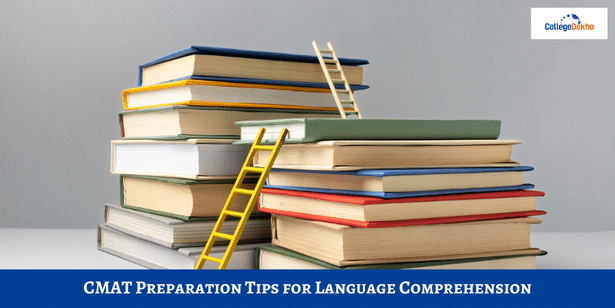
CMAT 2026 Preparation Tips for Language Comprehension:
The CMAT 2026 Language Comprehension section focuses mainly on reading comprehension and verbal ability. Also, with critical analysis, one can easily understand the questions and answer them. With one comprehension, there may be 4-6 questions carrying equal marks. Therefore, cracking the comprehension is the first stage in answering this section.
Candidates must be well-prepared in the section to score well in the upcoming
CMAT 2026
, which will be conducted on
January 25, 2026
. The difficulty level for language comprehension is usually moderate. But with due practice and preparation, it should not be too difficult. Candidates who have appeared for CAT or XAT will find it easy. Broadly, it is an easy section with a lot of tricky questions. Hence, you have to be careful while attempting them. Read the best CMAT 2026 preparation tips for Language Comprehension provided below.
Also Read
:
| CMAT 2026 Preparation Tips for Quantitative Techniques and Data Interpretation |
|---|
CMAT 2026 Syllabus for Language Comprehension
The language comprehension section for CMAT 2026 is simple and easy. The syllabus is also quite similar to any other MBA entrance exam. Therefore, it should be difficult to understand or complete the syllabus. Here are the topics to cover under the section:
Sentence Correction | English Grammar | Rearranging Sentences |
|---|---|---|
Paragraph Completion | Phrases | Reading Comprehension |
Idioms | One-Word Substitution | English Usage Errors |
Antonyms | Synonyms | Jumbled Para |
Preparation Tips for CMAT 2026 Language Comprehension
Candidates need to prepare well for Language Comprehension. The questions are tricky and confusing at times. This section is further divided into vocabulary, Reading Comprehension, Verbal Ability, and English Grammar. Preparation for these sections is necessary. Therefore, here are some tips to follow for CMAT 2026 Preparations for Language Comprehension:
Preparation Area | Detailed Preparation Strategy |
|---|---|
Early and Consistent Preparation | Language Comprehension is a skill-based section that requires long-term and consistent preparation. It cannot be mastered in just a month or two. Candidates should begin early and dedicate at least one to two hours daily to reading and language practice. Regular exposure to language helps build familiarity with sentence structures, tones, and contextual meanings, which are essential for comprehension-based questions. |
Daily Reading Habit | Reading books, novels, newspapers, magazines, editorials, and online articles is crucial. Diverse reading material exposes candidates to different writing styles, themes, and vocabulary levels. This habit strengthens reading comprehension skills and improves the ability to grasp the central idea, tone, and intent of passages quickly during the exam. |
Vocabulary Building | Strong vocabulary plays a vital role in Language Comprehension. While reading, candidates should note unfamiliar words, idioms, and phrases, learn their meanings, and understand their correct usage in sentences. Maintaining a vocabulary notebook and revising it regularly helps retain new words and improve accuracy in vocabulary-based questions. |
Understanding Context and Hidden Meanings | Merely reading is not enough; understanding the deeper meaning of sentences is equally important. Candidates should practice identifying implied ideas, assumptions, and hidden messages within passages. This skill is especially useful in inference-based questions, where answers are not directly stated but need logical interpretation. |
Word Games and Puzzles | Engaging in crossword puzzles, word games, and vocabulary quizzes is an effective and enjoyable way to enhance language skills. These activities improve word recall, spelling accuracy, and contextual understanding, making them an excellent supplement to traditional study methods. |
Prefixes and Suffixes | Learning commonly used prefixes and suffixes helps in decoding unfamiliar words during the exam. Understanding how word roots change meaning with different prefixes or suffixes allows candidates to make educated guesses, especially when encountering new vocabulary in comprehension passages. |
Grammar Fundamentals | A clear understanding of grammar is essential for sentence correction, sentence completion, and jumbled sentence questions. Candidates should regularly study grammar rules related to tenses, subject-verb agreement, modifiers, prepositions, and conjunctions. Practicing grammar exercises improves sentence construction and error detection skills. |
Abstract Comprehension Practice | Abstract or philosophical passages are often challenging. Practicing such comprehension helps candidates learn how to break down complex ideas into simpler points. During preparation, aspirants should practice summarizing paragraphs and identifying key arguments, which helps save time during the actual exam. |
Section-wise Mock Practice | Practicing mock tests for individual sub-sections such as Reading Comprehension, Vocabulary, Grammar, and Verbal Ability helps improve speed and clarity. Section-wise practice allows candidates to focus on weak areas and track improvement more effectively before attempting full-length mock tests. |
Sentence-Based Question Practice | Special attention should be given to jumbled sentences, sentence rearrangement, and sentence completion questions. These test logical flow and grammatical accuracy. Regular practice helps candidates quickly identify correct sentence order and contextual coherence. |
Exam-Day Reading Strategy | During the exam, candidates should read comprehension passages carefully and stay alert for contrast words such as “however,” “nevertheless,” “although,” and “instead of.” These words often signal a shift in meaning and are crucial for answering inference and tone-based questions accurately. |
Also Read :
| CMAT 2026 Preparation Tips for Innovation & Entrepreneurship | Tips on How to Prepare for Logical Reasoning Section for CMAT 2026 |
|---|
Reference Books for CMAT 2026 Language Comprehension
Candidates can refer to any books that they deem fit to cover the entire syllabus of CMAT 2026. Further, here are some books that you may refer to, particularly for the Language Comprehension section of the CMAT 2026 exam:
Name of the Books | Authors |
|---|---|
A Modern Approach to Verbal & Non-Verbal Reasoning | Dr R.S. Aggarwal |
Word Power Made Easy | Norman Lewis |
The Pearson Guide to Verbal Ability and Logical Reasoning for the CAT | Nishit K Sinha |
Trishna’s Verbal Ability and Logical Reasoning for the CAT and Other MBA Examinations | TIME |
How to Prepare for Verbal Ability and Reading Comprehension for the CAT | Arun Sharma |
High School English Grammar and Composition | Wren & Martin |
Check out the articles mentioned below to know more about CMAT 2026!
Related Articles:
For any doubts regarding CMAT 2026 or any other MBA entrance exam , write to us through the Q&A Zone . You can fill up the Common Application Form (CAF) or call the toll-free student helpline number 1800-572-9877 for any admission-related assistance. Stay tuned with us for more updates on CMAT 2026!
Are you feeling lost and unsure about what career path to take after completing 12th standard?
Say goodbye to confusion and hello to a bright future!

FAQs
Mock tests are important while preparing for CMAT 2026 Language Comprehension because they can aid in improving the ability of the candidates to do self-analysis. They can identify their strengths and weaknesses and gauge their preparation for the exam. Mock tests can also assist them in developing a plan for which questions to tackle first during the CMAT 2026 exam so that they can stay focused throughout the exam.
RC passages in the CMAT 2026 Language Comprehension section are based on themes like literature, art & culture, science, economy, sociology, history, philosophy, or geography.
Understanding root meanings of words, or etymology, is one way to approach vocabulary while preparing for the CMAT 2026 Language Comprehension section. For instance, understanding the meaning of the Latin word "loqui" will help you comprehend terms like "eloquent", "loquacious", "soliloquy", "ventriloquize", "circumlocution", "grandiloquent", and "magniloquent", among others.
The best way to enhance grammar and vocabulary for the CMAT 2026 Language Comprehension section is by learning new words, phrases and idioms, and reading a variety of English novels, magazines, and newspapers. Reading regularly will also enable you to understand Reading Comprehension (RC) passages. Reading books regularly can help you become faster and more efficient at reading lengthy paragraphs without skipping crucial details or context. While reading, make a note of any unfamiliar words, phrases, or idioms you come across to check their usage, meaning, and context. Play games that involve word meanings and crossword puzzles in your spare time. Additionally, learn and memorise how to use prefixes and suffixes. You may increase your vocabulary in English in an engaging way by doing this.
The best books to prepare for the CMAT 2026 Language Comprehension section are: ‘How to Prepare for Verbal Ability and Reading Comprehension for the CAT’ by Arun Sharma; ‘The Pearson Guide to Verbal Ability and Logical Reasoning for the CAT’ by Nishit K Sinha; ‘A Modern Approach to Verbal & Non-Verbal Reasoning’ by Dr R S Aggarwal; ‘Word Power Made Easy’ by Norman Lewis; ‘High School English Grammar and Composition’ By Wren & Martin.
The syllabus for the CMAT 2026 Language Comprehension section includes Reading Comprehension, Antonyms, Synonyms, English Grammar, English Usage Errors, Jumbled Para, Rearranging Sentences, Paragraph Completion, One-Word Substitution, Sentence Correction, Idioms, and Phrases.
There will be 20 questions in the CMAT 2026 Language Comprehension section. The questions will be in MCQ (Multiple-Choice Questions) format.
The difficulty level of the CMAT 2026 Language Comprehension section varies from easy to moderate. Candidates who are efficient enough to crack the English section of CAT or XAT can easily perform significantly well in the Language Comprehension section of CMAT.
There is only one reading comprehension passage of 300 words on the CMAT Language Comprehension section. The questions asked based on the passage will carry 4 marks each. English grammar and Verbal Ability are the topics of the remaining questions. Start your preparation early if you want to score well in this section.
Was this article helpful?















Similar Articles
XAT 2026: What to Do 1 Week Before Exam
How to Build a Strong MBA Profile for Top B-School Admissions
Cut-Off, Fees, Courses at ICFAI Business School Campuses Across India
Expert Tips to Crack Logical Puzzles in XAT DILR 2026
How to Build Mental Stamina for XAT DM Section 2026
IBSAT Cutoffs 2025 and Selection Process for IBS Campuses