


- Do or Die Chapters for COMEDK UGET 2026 Mathematics - …
- COMEDK Mathematics Important Topics
- High Weightage Topics COMEDK Mathematics
- COMEDK Mathematics Past Year Paper Analysis
- Expected COMEDK 2026 Mathematics Topic-Wise No of Questions and Difficulty …
- Study Tips for COMEDK Mathematics Most Important Chapters 2026

Preparing for the Mathematics section of the COMEDK UGET 2026 exam firstly requires meticulous planning followed by careful identification of the high-weightage mathematics topics for the exam. The maths section in the exam consist of 60 marks thereby making it crucial for you to know about the Do or Die Chapters for COMEDK UGET 2026 Mathematics. As per Ragi Ramu, having 10+ years of experience in teaching Mathematics in Vijayawada explains that the entire maths syllabus must be first divided into 3 levels, i.e. priority 1, priority 2 and priority 3. Priority 1 are significant units comprising of Matrices & Determinants, Vector Algebra, 3D Geometry, Differential Equations and Definite Integration. Priority 2 must comprise of chapters like Coordinate Geometry, Probability and Differential Calculus. Whereas, Priority 3 chapters are Sequence & Series, Inverse Trigonometric Functions, Sets, Relations & Functions and Complex Numbers.
As per his analysis, priority 1 topics are frequently asked in the exam usually comprising of direct formula based questions. These chapters must be first completed as these are non-negotiable units. In case of priority 2 units, these chapters usually are high weightage topics having high volume calculation intensive questions. For these topics Ramu Ragi tells that you must focus more on accuracy. Similarly for priority 3 topics, every year 1 to 2 questions are asked and if you know the formula then you can correctly solve them.
Also Read: COMEDK UGET 2026 Mathematics Syllabus, Important Topics, Preparation Tips
Do or Die Chapters for COMEDK UGET 2026 Mathematics - Priority Wise
As per the discussion we had with Ragi Ramu he clearly stated how you can sort the mathematics chapters as per their priority level. We have mentioned them in the below table.
| Level of Priority | Mathematics Chapters | Tips |
|---|---|---|
| Priority 1 |
| Non Negotiable chapters. Comprise of 45 to 50% of the paper. Every year 3 to 4 direct formula based questions are asked from these topics |
| Priority 2 |
| Usually high volume of questions are asked from these units. Focus more on your accuracy level |
| Priority 3 |
| Questions from these units can be quickly solved if you know the correct formula |
COMEDK Mathematics Important Topics
The core topics that you must prepare for the COMEDK UGET exam are mentioned in the table below.
| Units | Important Topics |
|---|---|
| Matrices & Determinants | Adjoint & Inverse, Properties of Determinants, System of Linear Equations (Cramer's Rule). |
| Vector Algebra | Scalar (Dot) & Vector (Cross) Product, Scalar Triple Product, Projection of vectors. |
| 3D Geometry | Equation of Lines & Planes, Shortest distance between lines, Angle between planes. |
| Differential Equations | Linear Differential Equations (Integrating Factor), Order & Degree, Variable Separable method. |
| Definite Integration | Properties of Definite Integrals (Kings Property), Area under curves. |
| Circles | Tangents & Normals, Family of Circles, Director Circle |
| Straight Lines | Distance formula, Angle between lines, Pair of Straight Lines |
| Conic Sections | Parabola (Standard forms), Ellipse & Hyperbola (Eccentricity & Latus Rectum) |
| Limits | L'Hospital's Rule (Crucial for speed) |
| Continuity & Differentiability | Basic conditions |
| Application of Derivatives | Maxima/Minima, Tangents & Normals, Rate Measure |
| Probability | Conditional Probability, Bayes' Theorem, Bernoulli Trials |
| Sequence & Series | AP, GP, AM-GM Relation, Special Series |
| Inverse Trigonometric Functions | Principal values, Property-based simplification |
| Complex Numbers | Cube roots of unity (ω), Modulus & Argument properties |
| Sets, Relations & Functions | Types of Relations (Reflexive, Symmetric, Transitive), Domain & Range finding |
High Weightage Topics COMEDK Mathematics
Here are the crucial high weightage topics from Mathematics section for the exam.
| Unit / Topic | Important Chapters | Approx. Weightage (%) |
|---|---|---|
| Algebra | Quadratic Equations, Permutations & Combinations, Probability, Sequences & Series, Complex Numbers, Binomial Theorem, Matrices & Determinants, Mathematical Induction | 30–35% |
| Calculus | Limits & Continuity, Differentiation, Application of Derivatives, Indefinite & Definite Integrals, Area Under Curve, Differential Equations | 30–32% |
| Coordinate Geometry | Straight Lines, Circles, Parabola, Ellipse, Hyperbola, Pair of Straight Lines | 18–20% |
| Trigonometry | Trigonometric Identities, Equations, Inverse Trigonometric Functions, Heights & Distances | 8–10% |
| Vectors & 3D Geometry | Vectors, Dot & Cross Product, Scalar Triple Product, Direction Cosines & Ratios, Line & Plane in 3D | 8–10% |
| Statistics & Mathematical Reasoning | Mean, Median, Mode, Standard Deviation, Variance, Logical Statements & Conclusions | 3–5% |
COMEDK Mathematics Past Year Paper Analysis
Madhusudhan Sir having 5+ years of teaching experience in Mathematics especially in Class 11 and 12 level explained the previous year high and medium weightage units and how many questions were asked from each unit in 2024 and 2026 exam. You can benefit by checking the below tables.
For your better understanding and as per Madhusudhan Sir's recommendation we have made 2 tables so that you can get an idea which topics you must focus on first and then move forward to the next topics.
Core Topics
| Unit / Chapter | Avg. No. of Questions (2024) | Avg. No. of Questions (2026) | Difficulty Level |
|---|---|---|---|
| Calculus | 16 - 18 | 17 - 19 | Hard / Lengthy |
| -- Definite & Indefinite Integration | 5 - 6 | 5 - 6 | Tricky, Property based |
| -- Differential Equations | 2 - 3 | 3 | Moderate |
| -- Limits, Continuity & Diff. | 3 - 4 | 3 - 4 | Easy to Moderate |
| -- Application of Derivatives (AOD) | 3 - 4 | 4 - 5 | Conceptual |
| Vector Algebra & 3D Geometry | 9 - 10 | 10 - 11 | Moderate (Scoring) |
| -- Vector Algebra | 3 - 4 | 4 | Formula Based |
| -- 3D Geometry (Lines & Planes) | 5 - 6 | 6 - 7 | Direct Formulae |
| Coordinate Geometry | 8 - 9 | 7 - 8 | Moderate |
| -- Circles & Straight Lines | 4 - 5 | 4 | Calculation heavy |
| -- Conic Sections (Parabola/Ellipse) | 3 - 4 | 3 | Standard Forms |
| Matrices & Determinants | 4 - 5 | 4 - 5 | Easy (Must Do) |
| -- Matrices & Determinants | 4 - 5 | 4 - 5 | Property Based |
Secondary Topics
| Unit / Chapter | Avg. Questions (2024) | Avg. Questions (2026) | Notes |
|---|---|---|---|
| Probability | 3 | 3 - 4 | Bayes' Theorem is common |
| Sequence & Series | 2 | 2 | AP/GP Sums |
| Sets, Relations & Functions | 2 - 3 | 2 - 3 | Types of Relations |
| Complex Numbers | 1 - 2 | 1 - 2 | Cube roots of unity (ω) |
| Trigonometry | 2 - 3 | 2 | Formula application |
| Inverse Trig. Functions (ITF) | 1 | 1 - 2 | Principal Value |
| Permutation & Combination | 1 | 1 | Rank of word / Teams |
| Mathematical Reasoning | 1 | 0 - 1 | Tautology/Contradiction |
| Binomial Theorem | 1 | 1 | General Term |
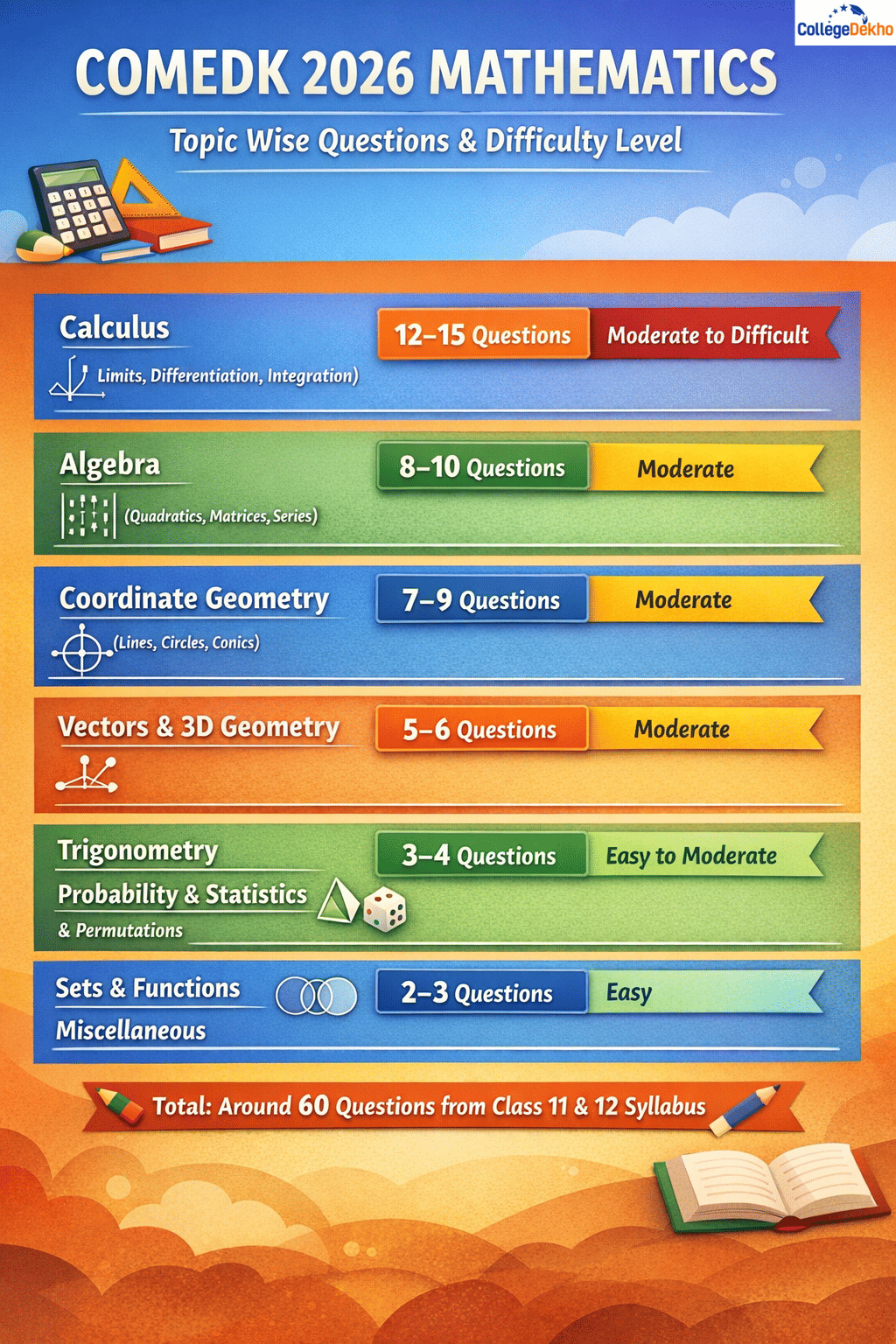
Expected COMEDK 2026 Mathematics Topic-Wise No of Questions and Difficulty Level
Here we have pointed out the no of questions that are expected from each topic as per the discussion with Ragi Ramu Sir and what could be the level of difficulty level.
| Unit / Module | Expected No. of Questions (2026) | Difficulty Forecast |
|---|---|---|
| Calculus (The Giant) | 12 - 15 | Time Consuming |
| Differential & Definite Integration | 3 - 4 | Hard. Many property-based Qs. |
| Limits, Continuity & Diff. | 4 - 5 | Moderate. L'Hospital's rule applies often. |
| Differential Equations | 3 | Easy/Moderate. Linear DE is standard. |
| Application of Derivatives | 1 - 2 | Moderate. Tangents/Normals & Max/Min. |
| Vector Algebra & 3D Geometry | 5 - 6 | High Scoring |
| 3D Geometry (Lines/Planes) | 2 - 3 | Formula-heavy but direct. |
| Vector Algebra | 3 - 4 | Moderate. Dot/Cross product applications. |
| Algebra (Core) | 10 - 11 | Mixed Bag |
| Matrices & Determinants | 4 - 5 | Easy. Guaranteed marks. |
| Probability | 2 - 3 | Tricky. Read carefully. |
| Sequence & Series / Complex No. | 2 - 3 | Moderate. |
| Binomial / Permutation | 1 - 2 | Often lengthy calculation. |
| Coordinate Geometry | 8 - 9 | Calculation Heavy |
| Circles & Straight Lines | 5 - 6 | Moderate concepts, long equations. |
| Conic Sections | 3 | Formula based (Eccentricity/Tangents). |
| Trigonometry | 4 - 5 | Easy |
| Trig Ratios / Inverse Trig | 4 - 5 | Easy. Basic identities & Principal Values. |
| Sets, Relations & Functions | 2 - 3 | Easiest |
Study Tips for COMEDK Mathematics Most Important Chapters 2026
To excel in the COMEDK UGET 2026 Mathematics exam, you are required to have a well-structured study plan and consistent practice is essential. Simply memorizing formulas won’t be enough, you are required to understand concepts, apply them efficiently, and improve problem-solving speed. The following strategic study tips will help you prepare effectively and boost your confidence for the exam:-
Visualize mathematical concepts through real-world applications: Instead of just memorizing formulas, relate them to practical situations. For example, think of quadratic equations when analyzing projectile motion, progressions when calculating interest in finance, and coordinate geometry when navigating a map. This will help reinforce your understanding and improve recall during the exam.
Engage in interactive learning to strengthen concepts: Use graphing tools like Desmos or GeoGebra to visualize straight lines, circles, and calculus graphs. Watching animated explanations of limits and derivatives can make abstract concepts like continuity and differentiability more intuitive.
Balance conceptual clarity with rigorous problem-solving: Mathematics requires consistent practice rather than passive learning. Focus on solving a variety of problems—ranging from formula-based to application-driven questions—to strengthen problem-solving speed and accuracy. Prioritize timed practice sessions to simulate real exam conditions.
Break down complex problems into step-by-step solutions: Instead of tackling lengthy problems at once, divide them into smaller, manageable steps. For instance, while solving integration problems, identify the best method first (substitution, by-parts, or partial fractions), then proceed systematically. Similarly, for coordinate geometry, sketch rough graphs to better visualize problem-solving approaches.
Use the Pomodoro technique for effective study sessions: Long hours of continuous problem-solving can lead to burnout. Instead, use the 50-minute study / 10-minute break technique to keep your mind fresh. Use breaks to revise formulas, recall key theorems, or practice mental calculations.
















Similar Articles
List of Colleges for 80-90 Percentile in JEE Main 2026
JEE Main 2026 Preparation and Study Time Table for 60 Days (2 Months)
JEE Main Marks vs Percentile vs Rank 2026
What is a Good Score and Rank in JEE Main 2026?
JEE Main Cutoff for Advanced 2026: Minimum Marks in JEE Mains to Qualify for JEE Advanced 2026
IIT Goa Summer Internship 2026: Eligibility, Important Dates & How to Apply