


To become a teacher, you might think of doing a B.Ed, as it is usually considered a prerequisite for all teaching jobs. But you need to know that it really isn’t a must for teaching at all levels.
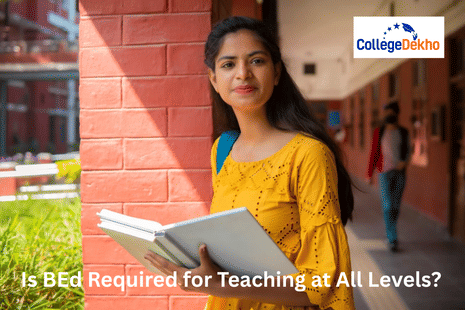
B.Ed or Bachelor of Education is an important degree, usually allowing graduates to start their career in teaching. Since its relevance has become well-known only for teaching purposes, future educators might think that they have to do it if they want to teach. However, you need to know that B.Ed is not the sole degree you need for teaching at all levels. In fact, you can even do without this degree for teaching in some areas. In this article, this is what we're breaking into, so you can be well-informed for your teaching career journey.
Also Check -
Is Distance B.Ed Valid for KVS Jobs?
B.Ed for Teaching at Different Levels– What’s the Reality?
Simply answering, B.Ed is not a must for teaching at all levels. The level, board, and institution will help you decide if you need to do a B.Ed or not. So, it’s important that you extract this information for the job you’re applying for before you dive into it. But we are providing a general outlook of how things are going in the nation currently and where B.Ed is coming into use.
Level | Is B.Ed Required? | Description |
|---|---|---|
Pre-Primary Level | No, B.Ed is not mandatory for pre-primary teaching in India. | Pre-primary teaching focuses on child psychology, basic pedagogy, and early learning methods. These areas are not deeply covered in B.Ed. Instead, the qualifications you should go for are
|
Primary Schools (Classes 1- 5) | B.Ed is not always required here. Traditionally, DElEd / BTC / JBT (Diploma in Elementary Education) worked. But since 2020, the National Education Policy (NEP 2020), proposed making an integrated B.Ed (a 4-year program) necessary for all school teaching levels. It’s in the future and hasn’t been enforced fully yet. | Teaching primary classes in government schools requires you to complete DElEd and CTET (Paper 1) or state TET. Private schools legally hire DElEd-qualified teachers for primary education, but B.Ed may also work. |
Upper Primary (Classes 6- 8) | Usually Yes | The recognised path for government or CBSE schools is:
A DElEd may also work if paired with CTET Paper 2, but B.Ed is the standard qualification. |
Secondary (Classes 9- 10) | Yes. In almost all cases. | You must have completed B.Ed with a relevant subject combination for CBSE, ICSE, and State Board schools. For example, as a maths teacher, you must have studied B.Ed with Maths in graduation or postgraduation. Government school recruitment (like KVS, NVS, DSSSB) also requires B.Ed mandatorily for TGTs. |
Senior Secondary (Classes 11- 12) | Yes along with additional qualifications | You must have completed B.Ed and a masters degree in the subject for postgraduate teacher (PGT) roles. Boards like CBSE, CISCE, KVS, NVS, State Boards strictly enforce this. |
Colleges or Universities | No | College teaching requires expertise in a specific discipline, not school pedagogy, so B.Ed is not a must. Instead, Master’s degree with 55%+ (in relevant subject), NET / SET / SLET qualification, or a PhD (as per UGC norms) is required. |
Coaching Institutions/ Ed-Tech/ Private Teaching Centers | No | These sectors hire based on subject knowledge, teaching ability, communication skills, and past performance. Degrees like BBA, BCom, BA, BSc, or even professionals (CA, engineers, designers) commonly teach in these institutions without B.Ed. |
International Schools (IB, IGCSE) | Highly preferred but not always necessary | International boards often require a Bachelor’s degree in relevant subject and eaching qualification (B.Ed / PGCE / PGCTL). Some elite IB schools prefer teachers with Master’s degree(s), International teaching certificates, and B.Ed still being the standard pathway. |
Also Check - How to Verify Fake B.Ed Colleges and Avoid Scams
Teaching in Government & Private Schools
As discussed above, here’s how private and government schools hire teachers:
Qualifications for Government Schools | Qualifications for Private Schools |
|---|---|
|
|
Related Articles
| UGC-Approved Distance Education Universities List 2025-26 | Career Options after B.Ed: Check Scope, Job Profile, Courses to Pursue after B.Ed |
|---|













Similar Articles
CTET Exam City Link 2026 (Active): How to Check City Intimation Slip
MAH B.Ed CET General Knowledge Syllabus 2026: Download PDF, Important Topics
CG TET 2026: Admit Card (Out), Exam Dates, Syllabus, Pattern, Result, Cut off
OTET 2025 - Answer Key (Out), Result (Soon), Cutoff, Selection Process
OSSTET 2026: Exam (Over), Answer Key (Soon), Result, Cut Off Marks
WB SET 2025: Answer Key (Soon), Result, Cut off, Selection Process