


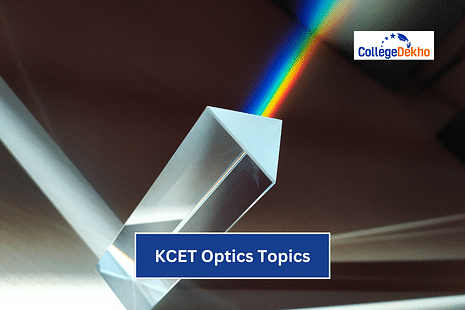
In the KCET Physics syllabus, optics is a crucial and high-scoring section that assesses both conceptual clarity and analytical application in the 2026 exam. In general, optics deals with the characteristics and behavior of light, how it interacts with various mediums, and the phenomena that result from these interactions. Learning this course requires KCET candidates to visualize and rationally explain how light travels, bends, interferes, and produces images in addition to remembering mathematics. For students who want to major in science and engineering, the subject is crucial since it connects theoretical ideas with real-world applications.
Each of the many subtopics covered in the KCET subject on optics has a unique relevance. The basis is laid by ray optics (geometrical optics), which studies the rules of reflection and refraction, how mirrors and lenses create images, and important phenomena like complete internal reflection. Students need to comprehend how light behaves at limits and how light is used to create images by optical devices like cameras, telescopes, and microscopes. Here, diagrams are essential, so mastering the creation and interpretation of ray diagrams is essential to correctly answering conceptual and numerical problems.
In addition to geometrical optics, the curriculum covers wave optics, which uses ideas like interference, diffraction, and polarization to describe how light is a wave. These events are frequently related to one another, providing greater understanding of the interactions between light waves and the patterns they create that cannot be explained by ray optics alone. For instance, comprehending the double-slit experiment strengthens analytical thinking and reinforces the wave nature of light, two abilities that are put to the test in KCET exam . Both basic comprehension and application-based problem solving are prioritized on the 2026 KCET. The questions are designed to evaluate students' ability to analyze diagrams, apply optical concepts to practical situations, and calculate outcomes using important relationships including lens/mirror formulas and refractive index computations. Solving a wide range of example problems, deriving and applying key equations, and grasping fundamental terminology are all important components of a good preparation plan. The Optics portion of the Physics paper can greatly improve a student's total score with concentrated study.
Also Check - KCET Subject Wise Syllabus
KCET Optics Topics 2026
Check the list of topics covered in the Ray Optics and Optical Instruments and Wave Optics in the following table.
| KCET Ray Optics and Optical Instruments Topics 2026 | KCET 2026 Wave Optics Topics |
|---|---|
| Introduction | Introduction |
| Refraction | Huygens Principle |
| Total Internal Reflection | Reflection and Refraction of Plane Waves |
| Refraction at Spherical Surfaces and by Lenses | Coherent and Incoherent Addition of Waves |
| Refraction through a Prism | Interference of Light Waves and Young’s Experiment |
| Some Natural Phenomena due to Sunlight | Diffraction |
| The Rainbow | The Single Slit |
| Optical Instruments | Seeing the Single slit Diffraction Pattern |
| - | The Validity of Ray Optics |
KCET 2026 Optics Important Topics
Check the table below to get an idea of important KCET 2026 Optics topics and Sub-topics.
Topics | KCET 2026 Optics Sub Topics |
|---|---|
Ray Optics and Optical Instruments |
|
Wave Optics |
|
KCET 2026 Optics Weightage
As per the previous years' analysis, candidates can expect at least 4 to 6 marks from Ray Optics and Optical Instruments and 2 to 4 marks from Wave Optics.
KCET 2026 Optics Topics | Weightage |
|---|---|
Ray Optics and Optical Instruments | 4 to 6 marks |
Wave Optics | 2 to 4 marks |
KCET 2026 Optics Books
The table contains the list of books and their authors/publishers that are suitable for KCET 2026 Optics Preparation.
- NCERT Physics Books from Class 11 and 12
- Concepts of Physics by H.C. Verma
- Understanding Physics for JEE Main & Advanced – Optics & Modern Physics by D.C. Pandey
- KCET Physics Chapter-wise and Topic-wise Solved Papers by Arihant Publications
- Objective Physics by Dinesh Publications
Quick Links:
KCET 2026 Optics Questions
1. Define total internal reflection.
When a light beam strikes the water, some of the light is reflected, and some are refracted. This phenomenon is called total internal reflection.
2. Dispersion can be observed through ______
- Wood
- Wall
- Paper
- Prism
Answer: d) Prism
Explanation: A prism is an optical device through which we can observe the dispersion of white light into its constituent colours.
3. Which among the following is the property of light?
- Diffraction
- Reflection
- Total internal reflection
- All the options
Answer: d) All the options.
Explanation: Light can undergo refraction, diffraction, reflection, and total internal reflection.
4. What are the types of images formed?
- Real
- Virtual
- Neither real nor virtual
- Both real and virtual
Answer: d) Both real and virtual.
Explanation: Images formed are of two types, real and virtual.
5. Light has the properties of
- Wave
- Particle
- Neither wave nor particle
- Both wave and particle
Answer: d) Both wave and particle.
Explanation: Light displays both wave and particle nature.
6. State true or false: Photons have a mass of more than two gms.
- TRUE
- FALSE
Answer: b) FALSE
Explanation: The photon is a massless quantity that moves at a vacuum’s speed.
7. The formation of images by mirrors is studied by:
- Geometrical optics
- Physical optics
- Neither Physical optics nor Geometrical optics
- None of the options
Answer: a) Geometrical Optics
Explanation: Geometrical optics deals with the formation of images by lenses, mirrors, and other devices that use light.
8. Choose YES or NO: The higher-density materials will have greater refractive indices.
- YES
- NO
Answer: a) YES
9. Refraction is used in devices like
- Cameras
- Projectors
- Telescopes
- All the above options
Answer: d) All the above options.
10. The bending of light when it passes from one medium to another is called_____
- Diffraction
- Reflection
- Total internal reflection
- Refraction
Answer: d) Refraction
Explanation: Refraction is the phenomenon that takes place due to the bending of light when it travels from one medium to another.
Related Article: KCET Physics Important Topics Chapters Weightage
If you are looking for admission into the top private engineering colleges in India 2026 , you can just fill out the Common Application Form on our website. It is a single application form for admission into various universities. For more articles and updates on KCET 2026, stay tuned with CollegeDekho.FAQs
The cutoff of KCET refers to the minimum marks required by candidates to qualify for the KCET exam. KEA KCET cutoff is released separately for the general merit and Hyderabad Karnataka region. The exam authority releases the KCET cutoff after each counselling round.
It is not mandatory to attempt the Biology paper in the KCET exam if you want to opt for Engineering. Biology marks are only considered for the Medical, Dental and Paramedical fields. However, if you want to pursue Biotechnology in Engineering, attempting Biology in the KCET exam is compulsory.
50% mark is the passing percentage for the general category candidates and 40% for the SC/ST/OBC category for the KCET exam.
As per the previous year exam analysis, the KCET 2025 exam might be of a moderate to difficult level. KCET questions will be based on the first and second-year PUC syllabus as determined by the Department of Pre-University Education of Karnataka State.
Candidates cannot skip Mathematics in the KCET exam. Mathematics is a mandatory subject in the KCET exam, and skipping it would disqualify candidates from the KCET examination.
Candidates looking to score good marks in the Karnataka CET exam are advised to solve the KCET previous year question papers and mock tests. Solving PYQs of KCET will enable candidates to get an idea about the KCET question paper pattern and the marking scheme.
The identical chapters and subjects from Classes 11 and 12 are covered by the questions in both KCET and JEE Main exams. However, in comparison to KCET, the questions in the JEE Main exam are more difficult.















Similar Articles
What is NTA score in JEE Main Results?
Documents Required to Fill TS ECET 2026 Application Form - Photo Requirements, Signature, Scanned Images
TS ECET Application Form Correction 2026 - Dates, Process, Edit
TS ECET 2026 Exam Day Instructions - Documents to Carry, Guidelines, CBT Instructions
JEE Main Safe Rank for IIIT CSE Admission 2026: Detailed Analysis of Previous Years' Trends
JEE Main 2026 Paper 2 (B.Arch, B.Plan) Answer Key (By Feb 15): Download PDF Response Sheet with Question Paper