

The CMAT 2026 normalization process, conducted by the NTA, ensures equal scoring fairness across different exam slots. It uses the percentile score approach, adjusting your marks for paper difficulty so that your final score reflects a balanced, unbiased ranking among all test-takers.

CMAT Normalization Process 2026: The CMAT 2026 exam will be held in two shifts, and the final scores will undergo a normalisation process to ensure fairness for all test-takers. Since each shift may have a different difficulty level, the normalisation method adjusts scores so that candidates are neither advantaged nor disadvantaged. In simple terms, if one paper is easier, marks for that shift may be adjusted slightly downward, while candidates who faced a tougher paper may see an upward adjustment. This process is based on a statistical formula used by the National Testing Agency (NTA) to maintain score equity across shifts. Understanding how CMAT 2026 normalisation works is essential if you’re planning to apply to MBA or PGDM programs using CMAT 2026 scores.
Also Read :
| What is a Good Score in CMAT 2026? | |
|---|---|
| CMAT Merit List 2026 | |
| Steps to Challenge CMAT Answer Key 2026 |
What is CMAT 2026 Normalization Process?
The NTA has confirmed that the CMAT 2026 results will be prepared using the normalization method based on percentile scores to ensure fairness across all exam sessions. Since the CMAT is conducted in multiple shifts, each paper may vary slightly in difficulty. To balance this out, NTA calculates the percentile score separately for every shift.
This means your performance will be compared only with other candidates who appeared in the same session. Later, these percentile scores are normalized to derive your final NTA Score, which appears on the merit list. By applying this process, NTA makes sure that no test-taker gains an unfair advantage or faces a disadvantage due to varying difficulty levels across shifts. The key goal of CMAT 2026 normalization is to present an accurate and unbiased reflection of each candidate’s true ability, maintaining a transparent and level evaluation process for everyone.
The details of how normalization is carried out by the NTA are given below:
Step 1: Distribution of Candidates
All of the candidates will be distributed randomly into the two shifts to avoid any bias. The two shifts can be conducted on the same day or multiple days, as specified by the NTA. In case the conducting body wishes to increase the number of shifts, the candidates can be divided accordingly into each shift. As an example, NTA has provided an example of the distribution of candidates for 4 Shifts.
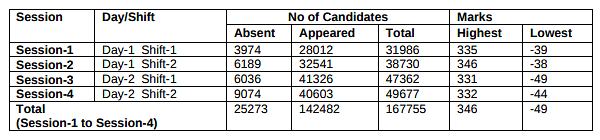
A random distribution of candidates would remove the chances of any bias in the shift allocation. The chances of bias would be further reduced with a large population of candidates appearing for the exam.
Step 2: Preparation of CMAT 2026 Result
NTA will prepare the CMAT 2026 results for each session. The result will be prepared in the form of the following scores.
- Raw Scores
- Percentile Scores of Total Raw Scores
The raw scores of the candidate will not be considered to identify their merit. Instead, NTA will consider the Percentile Scores calculated for each session for that purpose.
Calculation of CMAT 2026 Percentile Scores
The percentile compares the performance of a candidate relative to the other candidates who appeared for the exam. It is calculated based on the rank of the candidate. The candidate's percentile is the percentage of candidates in the same session as the candidate who has a score equal to or less than that of the candidate. The higher the rank of a candidate, the higher their percentile. The percentile ranges from 0 to 100 and is calculated using the following formula.
CMAT 2026 Percentile = [(No. of candidates in a 'Session' with equal to or less score than the candidate/ Total no. of candidates in the 'Session')] x 100 |
|---|
The Percentile Score will be calculated up to 7 decimal places to reduce the chances of ties and avoid the 'bunching effect'. Calculating the percentile score separately for each session will have the following effects:
- All of the candidates in the same session with the same raw score will have the same percentile.
- If two or more candidates in different shifts have the same raw score, their CMAT 2026 percentile will most likely be different.
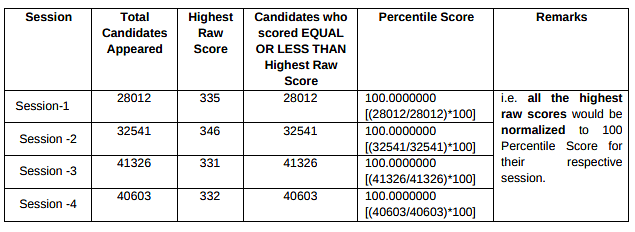
- All candidates who have the highest raw score for their session will be awarded the 100 percentile.
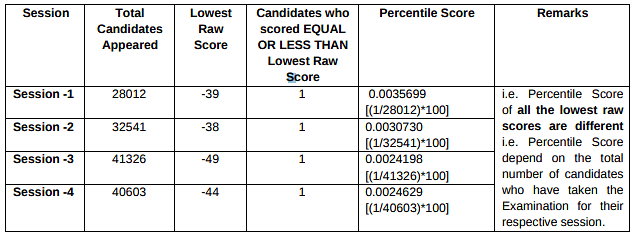
- All candidates who have the lowest score for their session will have a close to 0 percentile, depending on the number of candidates who appeared.
Let us understand the bottom two points further with examples given by the NTA.
Highest Raw Score and Percentile Score
As per the NTA, the normalized percentile scores for all of the highest raw scores will be 100 for their respective session. Given below is an example of the highest raw scores for an exam with 4 shifts.
Lowest Raw Score and Percentile Score
The percentile scores for all of the lowest raw scores will be close to 0. The exact score, however, will depend on the number of candidates who appeared for the session. Here is an example of the lowest raw scores for an exam with 4 shifts.
Step 3: Compilation of NTA Score
In the final step of the CMAT 2026 normalization, the percentile scores for all of the sessions are merged and called the NTA score. The scores can then be used for the compilation of results and in the CMAT selection process 2026 .
Important Information Regarding CMAT 2026 Eligibility Cut Off
There are chances that the percentiles for the different shifts on the same raw scores will be unequal. In such cases, issues may arise when deciding the eligibility cutoff. However, NTA has specified that the lowest percentile across all shifts for any particular raw score will be considered to be the eligibility cut-off. As an example. If 80 marks correspond to the 40 percentile in Shift 1 and 85 marks correspond to the 40 percentile in Shift 2, then all students who scored 80 and above would be considered eligible in both shifts.
Also Read :
CMAT Cutoff for Top Colleges
Percentile-wise Colleges Accepting CMAT 2026
Given below is the percentile-wise list of colleges accepting CMAT 2026:
Percentile | List of Colleges |
|---|---|
Percentile vs College | |
90+ Percentile | |
80 - 90 Percentile | |
70 - 80 Percentile | |
60 - 70 Percentile | |
50 - 60 Percentile | |
Low Percentile |
CMAT Marking Scheme and Number of Good Attempts
The CMAT exam has five sections, and each section is equally weighted. For each correct answer, you gain 4 marks, but for every incorrect answer, you lose 1 mark. If you do not attempt a question, then you neither gain nor lose marks; it will simply be marked as zero. Below, you will find a detailed table with the total number of questions and the recommended number of good attempts to aim for.
CMAT Sections | Number of Questions | Number of Good Attempts |
|---|---|---|
Quantitative Techniques & Data Interpretation | 20 | 16-17 |
Logical Reasoning | 20 | 16-17 |
Language Comprehension | 20 | 16-17 |
General Awareness | 20 | 8-10 |
Innovation & Entrepreneurship | 20 | 7-9 |
Once the CMAT percentile scores are calculated, the selection commission aggregates scores from all the shifts in the exams to calculate final NTA-CMAT scores. These NTA scores then form the basis for the merit list. For those candidates whose CMAT percentiles vary from shift to shift, the least percentile score becomes the CMAT cut-off for each category.
Related Links:
| What After CMAT 2026 Result? | |
|---|---|
| Didn't Score Well in CMAT 2026? Here Are Some Alternatives to Look For | |
| CMAT Question Paper 2024 |
These were all of the details about the CMAT normalization process 2026. In case of any doubts, candidates can post their questions on the CollegeDekho QnA Zone . To make your college applications easier, fill out the Common Application Form (CAF) or discuss your options with our counsellor at 18005729877.
Are you feeling lost and unsure about what career path to take after completing 12th standard?
Say goodbye to confusion and hello to a bright future!

FAQs
Yes, there is normalization in the CMAT 2026 exam. As the CMAT is conducted in multiple sessions, this process ensures that it is fair and addresses variations in the difficulty levels across different sessions. The normalization process adjusts the scores to a common scale so that candidates' performance can be compared fairly, regardless of the session in which they appeared. This normalized score is then used to calculate the final percentile.
- The CMAT normalization process ensures fairness, but it is not free from drawbacks.
- If their raw scores are reduced too much, candidates from easier sessions would be at a disadvantage.
- On the other hand, candidates from challenging sessions might see their scores inflated due to excessive upward adjustments.
- This would bring forth issues of justice and, therefore, scepticism regarding the validity of the ranking.
- Therefore, it may raise the question of the validity of the results.
A 99.99 percentile in the CMAT exam means scoring better than 99.99% of the test takers. This generally puts a score range of between 340 and 360 out of 400 marks. This percentile would open up the gates for management institutes that accept CMAT scores, such as JBIMS, SIMSREE, and GIM to a great extent.
Yes, normalization in the CMAT may increase your raw score. Normalization adjusts the scores according to the toughness level of different sessions in which the exams are taken. If your session is slightly tough, your raw score might be scaled up to match with scores from easier sessions so that all test-takers are treated equally. This process is to bring in a level playing field and may help increase your final CMAT score.
The CMAT 2026 exam will have 100 questions, with 20 questions in each of the five sections. You do not have to attempt all the questions; the total score for the examination will be 400 marks.
The percentile compares the performance of a candidate relative to the other candidates who appeared for the exam. It is calculated based on the rank of the candidate. The candidate's percentile is the percentage of candidates, in the same session as the candidate, who has a score equal to or less than that candidate. The higher the rank of a candidate, the higher their percentile.
CMAT score vs percentile is a detailed analysis of what score was required to attain a certain percentile in the exam. If a candidate scores between 315-350, then he may get a 100 percentile. Similarly, if a candidate scores between 286-310, then he may get a percentile between 99.1 – 99.99.
CMAT normalization process is used by the NTA to adjust the scores of test-takers according to the difficulty level of their question paper in their shift. Through normalization, the score of a candidate who faced a tougher question paper will be increased and the score of a candidate who faced an easier question paper will be decreased.
CMAT normalization process ensures that no candidate benefits or is put at a disadvantage due to the difference in the difficulty level of the question paper for their shift. During the normalization process, the score of candidates who faced a difficult paper will be increased while the score of candidates who faced a simple paper will be decreased to ensure there’s no disparity.
CMAT normalization process is conducted by the National Testing Agency (NTA), the conducting body for CMAT. Through the CMAT normalization process, NTA ensures that each candidate is fairly evaluated irrespective of the difficulty level of the question paper in various shifts.
Was this article helpful?

















Similar Articles
XAT 2026: What to Do 1 Week Before Exam
How to Build a Strong MBA Profile for Top B-School Admissions
Cut-Off, Fees, Courses at ICFAI Business School Campuses Across India
Expert Tips to Crack Logical Puzzles in XAT DILR 2026
How to Build Mental Stamina for XAT DM Section 2026
IBSAT Cutoffs 2025 and Selection Process for IBS Campuses