

- We’re on your favourite socials!


 Chittorgarh (Rajasthan)
 Gallery

Mewar University News

CUET BA LLB University List 2026: Central & Private Universities
BA LLB, an integrated law program, becomes accessible to students post their completion of Class 12 exams. This five-year degree entails a study of both LLB and other Arts disciplines. CUET BA LLB university list for 2026 comprises more than 100 universities offering Law programs this year. A growing number of central, state, private, and deemed institutions are using CUET UG scores in their selection procedures for law programs as the National Testing Agency (NTA) continues to standardize and broaden CUET's involvement in higher education admissions. As it lists the universities where candidates can apply using their CUET scores, this list is an essential tool for prospective law students. It helps them make well-informed decisions based on eligibility requirements, program options, reputations, and geographic preferences. Notable participating universities include a mix of well-established central institutions and private law schools such as Assam University, Babasaheb Bhimrao Ambedkar University, Central University of Kashmir, Amity University Gurugram, Babasaheb Bhimrao Ambedkar University, Chanakya University, Graphic Era Hill University, Sharda University, BML Munjal University, North-Eastern Hill University, and several others, each offering integrated BA LLB or related law degrees under CUET-based admissions.
Related News
SKCET Placement Highlights 2025-26: Average and Highest Package Trends
The SKCET placement statistics have always maintained a very strong record over the years in the field of engineering. In 2025, the highest package offered by a company during SKCET placement was Rs. 60 LPA, and the average package was around Rs. 7 LPA. Over 234 companies reportedly visited during the placement sessions last year, and more than 1,500 offers were made. For the SKCET placement 2026, the expected highest package is likely to exceed Rs. 62 LPA, while the average package may be around Rs. 8 to 10 LPA. Companies like Amazon, Accenture, Axis Bank, etc., are usually among the list of top recruiters. To understand more about the SKCET placement statistics in detail, keep reading the article till the end!

Do or Die Chapters for COMEDK UGET 2026 Chemistry
Chemistry in COMEDK UGET plays a pivotal role in shaping an aspirant’s overall score, with 60 questions dedicated entirely to this subject in the PCM paper. Chemistry is distributed across Organic, Inorganic, and Physical Chemistry, and questions are drawn directly from Class 11 and 12 syllabi, with a relatively balanced mix of conceptual, numerical and memory-based problems. Over the past few years (2022 to 2026), the difficulty level of the Chemistry section has generally ranged from easy to moderate for well-prepared students. In COMEDK UGET 2025, many candidates found Chemistry to be comparatively straightforward, with questions largely rooted in NCERT concepts and basic understanding, providing opportunities to score high with proper preparation. Organic Chemistry, Chemical Bonding, and Thermodynamics featured prominently, and the section was often seen as one where time could be saved relative to Mathematics or Physics when strategy and practice were aligned.

Do or Die Chapters for COMEDK UGET 2026 Physics
Physics in the COMEDK UGET exam plays a pivotal role in determining a candidate’s overall rank—often acting as a differentiator between high scorers and the rest. Unlike Mathematics or Chemistry, Physics demands both conceptual clarity and application-oriented problem solving. Over the years, the examination pattern of Physics in COMEDK has remained consistent in terms of syllabus coverage, drawing predominantly from classical mechanics, electromagnetism, modern physics, thermodynamics, and optics. from COMEDK UGET 2022 to 2025, the overall difficulty level of the Physics section can be described as moderate to slightly challenging. Questions were mostly straightforward concept checks mixed with a fair number of application-based problems. Mechanics—especially kinematics, laws of motion, work-energy and rotational dynamics—consistently appeared with multiple questions. Electrostatics and Current Electricity also remained core scoring areas, often contributing significantly to the total marks. Topics like Waves and Oscillations, Thermodynamics, and Optics and Modern Physics regularly featured 1–2 questions each, testing both fundamentals and analytical skills.

98+ Percentile in JEE Main 2026 Predictions and Expectations
98+ percentile in JEE Mains estimates a score ranging from 131 - 165.3, depending on the exam difficulty level. Furthermore, the predicted rank for this percentile is around 30,000. This performance in the exam is considered to be of a strong level as it allows the candidate to get admitted to various top-tier colleges in core engineering branches; however, less competitive ones. Understanding the 98+ percentile in JEE Main 2026 prediction is crucial for the candidates as it will help them in targeting their favourite colleges and courses accordingly.
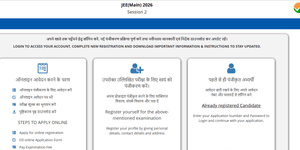
JEE Main Application Form 2026 Session 2: Important instructions for already registered candidates
Important Instructions for already Registered JEE Main 2026 Applicants
Here are the important instructions listed by NTA for the already registered candidates of JEE Main 2026 -- You can add a new course/ change the course while registering for Session 2. For example, if you appeared for only Paper 1 (B.Tech) in Session 1, they can add Paper 2 (B.Arch) as well during the Session 2 registration. You can even appear for both papers
- There is an option to change the 'Medium of Question Paper', i.e., the language of the question paper. There is no separate fee for the same
- You can opt for exam cities again. It is not mandatory to choose the same exam cities as those opted during the Session 1 registration. You can choose different exam cities as per your convenience or you can choose the same exam cities
- You need to pay the application fee for Session 2 for all the papers opted (Paper 1 or Paper 2 or both) through digital payment methods
Also read | CBSE Admit Card 2026 for Class 10 and 12 likely on February 3: Only schools have access to download
Top Courses at Mewar University
Related Questions
Related News






Similar Colleges


Explore More Engineering Colleges in Rajasthan
By Degree
By Specialization

